Val McDermid, The Distant Echo
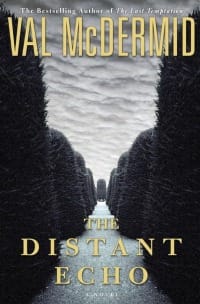
At four o'clock in the morning in December of 1978, four students from St. Andrews School in Scotland stumble across the bloodied body of barmaid Rosie Duff. She is still alive, if barely, and the fastest of the students, Alex Gilbey, runs off through the blinding snow to find help. He eventually staggers up to a police car, covered himself in Rosie's blood and soaked in sweat, looking, he is uncomfortably aware, more like a man guilty of murder than a respectable citizen reporting a crime. Sure enough, in the absence of other suspects, Gilbey and his friends, the self-styled "Laddies fi' Kirkcaldy," are suspected of the murder—Rosie dies shortly after the boys find her—though definitive proof of their guilt is never uncovered.
The murder investigation of 1978 and its repercussions for the four students are the subject of the first part of The Distant Echo. The second part opens twenty-five years later, when Rosie's murder is reinvestigated as part of a cold case review. Modern forensic techniques such as DNA analysis will, it is to be hoped, finally exonerate Gilbey and his friends and bring the real killer to light. But, of course, things don't go as smoothly as one would like for the Laddies fi' Kirkcaldy....
It is a measure of McDermid's success that one cannot be at all confident about the identity of Rosie's killer until it is revealed at the book's end. Until then, even the unlikeliest of suspects seem as if they just might have committed the crime. The Distant Echo is tense—I read the last 120 pages or so in one sitting, it being impossible not to do so—and its complex characters well drawn. I am not convinced that in the end the motivation of the killer makes perfect sense, but my niggling doubts are far outweighed by my appreciation of the good read McDermid has given us.
Member discussion