Trying Neaira
— The Sunday Telegraph
About the book
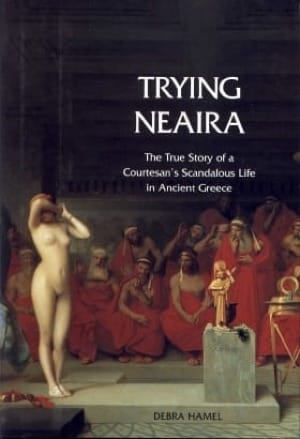
Neaira (pronounced "neh-EYE-ruh") grew up in a brothel in Corinth in the early fourth century B.C. She became one of the city-state's higher-priced courtesans while still a teenager. In the next decade she served as the sex slave of two former clients and endured an abusive relationship with a party-hopping Athenian. Finally, barely supporting herself in a sex industry depressed by the war then raging in Greece, she met Stephanos, an Athenian citizen, with whom she would live for the next thirty years or more. Neaira's life with Stephanos was far from tranquil: it was riddled with legal threats and lawsuits. On one occasion in particular the former courtesan herself was dragged into court. The stakes in the case were high, as Neaira's very freedom lay in the jurors' hands. . . . The story of Neaira and her appearance in court is well known to classicists, but Trying Neaira is the first book to tell Neaira's story to a non-specialist audience. The book serves also as a lively introduction to the larger world of fourth-century Greece, and of Athens in particular, in which Neaira's drama played itself out.
Translations
Translations of Trying Neaira have been published in German, Greek, Korean, and Japanese.

Reviews
The New Republic
"Hamel's treatment of this complicated story is outstanding not only for its comprehensive (yet remarkably concise) presentation of the social and historical context of fourth-century Athens, but also, perhaps supremely, for its tact. By presenting sex and the ancient Greek sex trade forthrightly, she puts to shame the ponderous cuteness and leering euphemism that writing about Neaira's case has aroused in many classicists over the centuries. She brings out both the sordid exploitation of Neaira's circumstances and the genuine strength of the bond that linked this former prostitute with Stephanos and his family, piecing together a plausible account from what is often minimal evidence, managing to explore her human characters without idealizing them, and judiciously staying just shy of a historical novel."
The Globe and Mail
"Hamel reconstructs Neaira's life and her trial, providing as well a lively social history of the time and place."
Erotic Review
"...under its thin veneer of toga-and-sandal skin-flick is a work of first-rate scholarship."
"...Hamel can write, she can think, and she is, accordingly, published by Yale. She turns one of antiquity's more fibrous epochs into a lively and witty slice of history, and gives us a story of cupidity, greed and obduracy, spiced with sexual morsels."
Library Journal
"In the future, this work will be a part of reading lists for courses on the Greek orators. Hamel...has taken the speech Against Neaira by Apollodoros and written a commentary on Athenian culture of the fourth century B.C.E. The work deals with the social mores of the period in abundant detail. Indeed, when focusing on the orator's privilege of manipulating the facts, Hamel's grasp of the current scholarship on Athenian law is formidable. She estimably deciphers the convolutions of Neaira's life as a courtesan in Corinth and Athens. ...Any scholar will enjoy this well-documented work. Recommended for upper division undergraduate and graduate students."
The Daily Telegraph
"It is an extraordinary tale, with more than an echo of Arthur Golden's Memoirs of a Geisha, and Hamel, unusually for a classicist, is not afraid of a good narrative. Nor of racy detail: from street-walkers imprinting come-hither messages in the dust with their sandals, to outraged cuckolds shoving radishes up adulterers' bottoms, there is plenty here to delight the most prurient reader."
The Sunday Telegraph
A "gripping story of politics, sex and sleaze in ancient Athens...."
The Scotsman
"As told by Debra Hamel, this true-life story offers an extraordinary window on a civilisation that wasn't half so rarefied in its interests or affections as we tend to assume."
The Chronicle of Higher Education
"Describing, challenging, and fleshing out the text, the scholar sends the reader on a tour of Greek culture and custom linked to the case and the feud. Among the stops are the demimonde hierarchies of prostitution, a raucous Greek jury system, the ancient and very different meaning of sycophant, and a vivid description of how seducing a respectable Athenian's wife or daughter could lead to a fine, death, or correctional intimacy with a root vegetable."
Choice
"Hamel...provides a charmingly written, nicely illustrated, and generally convincing analysis of the lurid Athenian speech 'Against Neaira.'"
"Hamel's account is engaging, accessible to nonexperts, and useful for courses on Athenian society...."
Journal of the History of Sexuality
"While the book is written in a fluent, simple style that makes it accessible to the student and the layperson, behind it lies a wealth of scholarship and learning."
"There is plenty of material in the book that will prove very useful to classical scholars, ancient historians, students of the speech, and every undergraduate student who is trying to become acquainted with women's history, the history of sexuality, and, in general, life in ancient Greece."
Classical Review
"Overall Trying Neaira presents Neaira's story—and the numerous points of social history it raises—in a clear and lively style aimed at the Greekless and 'Greek history-less' reader.... Undergraduates can read the book as an enthusiastic introduction to some of the major issues of Athenian social history, but most likely will need to turn to other sources, primary and secondary, for further study. And the general reader, if enticed to look inside by the cover and title, will discover a colorful story that brings to life the society of Athens in the fourth century B.C.E."
Scholia Reviews
"...Hamel does not simply concentrate on the illogicality of Apollodorus' arguments or on the complex political context of the trial. She explores the wider social and legal background, fleshing out Neaira's extraordinary life with interesting discussions of prostitution, citizenship, slave torture, courtroom procedure and even jury selection in fourth century Athens, which she describes as 'delightfully complicated' (p. 147). Herein lies the strength of Hamel's work: the accessibility of these brief discussions makes the book an ideal introduction to the study of women in antiquity, especially in Classical Civilization courses in which no knowledge of Greek is required."
"Hamel provides her own snappy translations of extracts from Apollodorus (and others), attempting to give as accurate a version of the original as possible (for her approach to translating some of the 'Proustian' sentences of Apollodorus, see p. 183, n. 3). She generally writes with great verve and humour, which makes the footnotes interesting reading (and how often can one say that!): her husband is thanked for his familiarity with Dutch prostitution (p. 164, n. 5); she seems to think that some readers may be interested in the 'logistics of mid-trial dicastic excretion' (p. 182, n. 26)."
"Hamel's work makes a notable contribution to the important process of uncovering the lives of women in antiquity and restoring them to history.... The fact that we have access to the life of a prostitute like Neaira, which has been excavated, in so engaging a manner, from yet another male- produced text, is something to celebrate."
JACT Review
"H., who has previously published a study of the Athenian generalship, does justice to the many facets of the speech in this scholarly and highly entertaining book. She deploys a wide range of other sources and comparative evidence (fragments of comedy, accounts of Japanese geisha). She has a nice turn of phrase (the first husband of Neaira's alleged daughter was 'a pitchfork-wielding American Gothic kind of fellow'). She has (probably unlike most of the original male jury) real and moving sympathy for Neaira, who was 'not the real target...yet had most to lose from the trial.'"
"Although we are several decades on from the Athens of Aristophanes, there is much here to illuminate Wasps, or to provide background to the Culture of Athens topic in JACT Ancient History. The book has clear and useful maps, diagrams and chronological charts, and is excellent value. Sixth-form students could read it with profit and pleasure."
Bryn Mawr Classical Review
"...the end result is a little gem of a book from which everyone will profit. It is informative, serious in its approach, use of source material, and conclusions, and commendably it is written in an unpretentious style."
"Needless to say, I liked H.'s book a lot, and to judge from the enthusiastic endorsements on its cover I am not alone. And it is a book that needed to be written. All too often we focus on some technical aspect of a society, or on why such-and-such a verb is in the passive, and we end up losing sight of the people who make up the society. Neaera as a person gets lost in Apollodorus' speech, but H. redresses that lack. In the process we cannot help but have a new feeling of sympathy for Neaera."
Frankfurter Rundschau
"Und dennoch gelingt ihr das Kunststck, diese zweieinhalb Jahrtausende zurckliegende Geschichte so spannend zu erzählen, dass sich das Buch streckenweise liest wie ein Krimi."
"...eine ebenso lehrreiche wie vergnügliche Lektüre."
Bulletin of the Schweizerischer Altphilologenverband
"Wie die Autorin mit akribischem Spürsinn versucht, Apollodoros' Aussagen auf ihren Wahrheitsgehalt hin zu überprüfen, ist ein weitere Aspekt, der die Lektüre dieses Buches nicht nur empfehlenswert, sondern zu einem wahren Genuss macht."
Die Welt
"Debra Hamel erzählt die Geschichte der Hetäre Neaira anhand einer Gerichtsverhandlung, deren Reden von ihr ausgewertet wurden. Und aus denen sich ein sehr plastisches Bild der sozialgeschichtlichen Situation des antiken Griechenland ergibt. Amüsant, seriös und mit Chronologien und Karten versehen. Die schönste Geschichte darin ist die, die uns erzählt, wie mit ehebrecherischen Männern umgegangen wurde. Einfach einen Rettich in den Allerwertesten. Dann war Ruhe. Strafe muss sein."
Sehepunkte: Rezensionsjournal für die Geschichtswissenschaften
"In dem hier anzuzeigenden Buch erzählt Hamel die Lebensgeschichte der Neaira in brillantem Stil und in ausgewogener Form nach."
In the Blogosphere
"There are academic authors who seem to think that scholarly and accessible are by necessity opposites, so making a book unreadable somehow automatically makes a book more scholarly. The great thing about this book is that it smacks that notion down. You can read it for pleasure, but the references and notes also make it suitable for an undergraduate text."
— History News Network
"TRYING NEAIRA is that rare sort of book that informs and entertains in equal measure."
— Keeper of the Snails
"Mystery, intrigue, lascivious behavior, sensational speeches, and controlled anger among the real-life characters make this an interesting study of ancient Greek history and people."
— BOOK reMARKS
"Debra Hamel's Trying Neaira is an object lesson in how to write a non-fiction book which has academic credibility and yet remains easily comprehensible to the general reader.
— Grumpy Old Bookman
"The amount of information Hamel packs into this book is testament to her concise prose style and superior knowledge of ancient Greek society and the reader will finish this book amazed at the amount of knowledge they have absorbed."
— Scarecrow Reviews
"For anyone interested in the culture and institutions of ancient Greece, this book is a must read. Recommended."
— Damian McNicholl's Blog
"Trying Neaira is just what one would NOT expect an historical nonfiction book to be—witty and easy to read, with little bizarre bits that one just MUST read out loud!"
— Blue Ampersand Reviews
"Trying Neaira is written for the non-specialist—no knowledge at all of Greek history or literature is assumed—but endnotes provide references for the cognoscenti. It's a lot of fun to read, but Hamel's biggest service is in providing a radically different entry point to classical Athens, one that doesn't involve triremes or tragedies."
— Danny Yee's Book Reviews
"As absorbing as a mystery story." Guide Rating 5 stars
— Ancient/Classical History at About.com
From the Back Cover
Victor Bers, Yale University
The subject matter of Trying Neaira suggests a supermarket tabloid—prominent politicians and their favorite hookers; but in fact this bok is a richly informative, exuberant short course in the politics, legal system, and social mores of Athens in the fourth century B.C. The prose is elegant and deliciously ironic, the scholarship fastidious and up-to-date.
Mary R. Lefkowitz, Wellesley College
This clearly written, entertaining, and well-informed book is a wonderful means of entering the world of fourth-century Athens.
Donald Kagan, Yale University
Debra Hamel has written a marvelous account of a fascinating series of events in the life of a Greek woman of the fourth century B.C. She tells the tale with clarity and verve and, along the way, she teaches the reader a vast amount about Athenian society in the most interesting and entertaining way.
Read the Preface
The prosecutor was in his early fifties, boorish and unattractive, to judge by the description he had given of himself some ten years before, and with a booming voice that carried well in the court. It was early yet, an hour or two into a trial that would last the rest of the day. The 501 jurors hearing the case were not yet distracted by grumbling stomachs and the thought of collecting their wages when the verdict was in. Apollodoros was just getting started on his denunciation of the defendant, Neaira (pronounced "neh-EYE-ruh"). "A bunch of them had sex with her while she was drunk," he tells the jurors, describing the aftermath of a dinner-party given some thirty years before. "Even the slaves." And Apollodoros had the testimony of witnesses to substantiate the story. The lurid account of Neaira's alleged youthful revelry was at best only tangentially related to the prosecution's case. But in the Athenian lawcourts of the fourth century B.C., relevance, and the truth itself, very often took a back seat to a more urgent concern, rousing the jurors' hostility, by any means possible, against one's opponent.
At the time of her trial Neaira was a foreigner resident in Athens. "Foreigner" in this context means only that Neaira was not an Athenian citizen. She had emigrated to Athens from Megara, another one of the some 750 independent city-states (or poleis, the plural of polis) into which Greece was divided at the time. (The emergence of Greece as a united nation awaited the Greek War of Independence in the early nineteenth century.) Neaira had grown up in another Greek polis, Corinth, in the northeast of Greece's Peloponnese, but we cannot know whether she was herself of Greek extraction: Corinth was a flourishing center of commerce, and traders from throughout the Mediterranean regularly passed through its ports. We know, at least, that Neaira lived in Corinth from a very young age, and possibly from birth. She would therefore have spoken Greek fluently—but the Doric dialect of Greek that was prevalent in the Peloponnese, not the Attic dialect of Athens. Neaira's speech would have been perfectly understandable in her adoptive polis, but unless she had managed in adulthood to change her pronunciation, her accent would have distinguished her from native Athenians.
Neaira was born in the decade after Athens lost the Peloponnesian War to Sparta and the Peloponnesian League (404 B.C.). (All the dates in the narrative are B.C. unless otherwise indicated.) By the time of the trial, sometime between 343 and 340, she too was in her fifties. She had spent much of her life working as a courtesan, her fate largely sealed when she was enslaved as a child to a Corinthian brothel-keeper. But in many ways Neaira had been successful. She had gained her freedom and eventually settled into a thirty-year relationship with a certain Stephanos, an Athenian citizen. The nature of that relationship was the central question in her trial.
Apollodoros was attempting to show in his speech that Neaira had broken the law by living with an Athenian citizen as his wife (rather than, for example, as a mistress): at the time of Neaira's trial, marriages between citizens and noncitizens in Athens were illegal, though less formal relationships between lovers were unproblematic. Conviction in the trial would result in Neaira's enslavement—Athenian courts regularly imposed what most of us would consider impossibly harsh sentences—while Stephanos would be punished with a stiff fine, the equivalent of two or three years' worth of a skilled laborer's wages. Apollodoros was not particularly interested in destroying Neaira. Her enslavement, if he managed to persuade the jurors that punishment was called for, would merely be collateral damage in the feud he was pursuing with Stephanos: the two had faced one another in court before. Humiliating Neaira in public, dredging up—or inventing—sensational details about her past, was simply a means of retaliating against Neaira's lover.
We can be excused for taking pleasure, two and a half millennia after the fact, in Apollodoros' attack on Neaira. The speech he delivered in court has been preserved and is an important source of information about Athenian law and social history. It has something to tell us about a host of different subjects—prostitution, adultery, religious practices, slavery, enfranchisement procedures, private arbitration, homicide law, and so on. Not least, it has preserved for us most of what we know of Neaira's story, a rare view of a woman's life—admittedly an unusual life—in ancient Greece.
Apollodoros' speech is one of about a hundred Athenian lawcourt speeches that have survived completely or largely intact. Between roughly 420 and 320, speechwriters in Athens, probably several score of them, were regularly composing speeches for delivery by themselves or others either in court or before the Athenian assembly of citizens. (There was another recognized type of speech as well, however, the "epideictic," display oratory written for the amusement of an author's audience or for a public occasion such as the burial of Athenian soldiers.) Speeches written by or attributed to ten of Athens' speechwriters were collected in antiquity and preserved. The canonical authors, the so-called Ten Orators, are Aeschines, Andocides, Antiphon, Demosthenes, Dinarchus, Hyperides, Isaeus, Isocrates, Lycurgus, and Lysias. (We will be hearing more about the last of these men in Chapter 1.) A number of speeches attributed to the more distinguished orator Demosthenes are believed to have been written in fact by Apollodoros, Neaira's prosecutor, who is sometimes referred to as the eleventh Attic orator (by, for example, Lionel Pearson in the title to his 1966 article, "Apollodorus, the Eleventh Attic Orator"). In particular, the speech Apollodoros delivered at Neaira's trial was very probably composed by him as well. (There is general agreement that the following six speeches in the Demosthenic corpus were composed by Apollodoros: 46 Against Stephanos II, 49 Against Timotheos, 50 Against Polykles, 52 Against Kallippos, 53 Against Nikostratos, as well as 59 Against Neaira.)
Like any of the extant Athenian lawcourt speeches, Apollodoros' Against Neaira has to be used with care. Litigants in Athenian trials regularly distorted the information they presented to juries, misrepresenting the situations under discussion or indeed lying outright in order to achieve their purposes. A prosecutor might even misrepresent the law or laws at issue in a case in order to confuse jurors and exaggerate the defendant's culpability. This degree of prevarication may seem surprising: we in modern democracies are accustomed to a legal system in which trials are overseen by professional judges who instruct jurors in the correct understanding of the laws pertinent to a trial. But there were no professional jurists in Athens. What litigants could get away with in a courtroom was defined not by rulings from the bench but by the response of the jurors themselves, from supportive murmurs to heckling to questions shouted from the floor to the final verdict. We can assume that Apollodoros, like any Athenian orator, was less than truthful in his speech when he needed to be and when he thought he would not be found out.
This book tells the story of Neaira's life and of her family's experiences, culminating in Apollodoros' prosecution of her in the late 340s, with attention given also to the feud that occasioned the trial. Apollodoros' speech, inevitably hostile to Neaira, must be the principal source for her biography, though we will need very often to question and reject the information he provides. Where what he tells us is not inherently unlikely, however, or contradicted by other sources, and when lying about the issue under discussion would not have furthered the prosecution's case, we can feel reasonably confident about accepting Apollodoros' testimony. Fleshing out Neaira's story, too, will require frequent dips into other source material.
Any citations by section number alone in this book are to be understood as referring to Apollodoros' speech against Neaira (unless some other referent is obvious). All translations from the Greek are my own.
Konstantinos Kapparis (1999) and Christopher Carey (1992) both provide translations of the complete text of Against Neaira in their commentaries. A recent translation by Victor Bers of this and nine other speeches in the Demosthenic corpus can be found in the Oratory of Classical Greece series published by the University of Texas Press. Because Against Neaira was preserved in the Demosthenic corpus, texts and translations of it will almost invariably be found in compilations of his work (as speech 59) rather than under the name of Apollodoros. Readers may also be interested in Carey's Trials from Classical Athens, a selection of sixteen Athenian lawcourt speeches by various authors, with introductions and explanatory material.
Every classicist writing in a modern language about ancient Greece must decide what transliteration scheme to adopt—whether to write Peiraieus or Piraeus, for example, Eunikos or Eunicus. I follow the majority in opting for inconsistency. I use Latinate spellings (c for k, -us for -os, etc.) for the more familiar terms and names while transliterating less well-known words directly from the Greek.
For the convenience of the reader, I summarize here the relationship among the ancient monetary units mentioned in the text:
6 obols = 1 drachma
1 mina = 100 drachmas
1 talent = 6,000 drachmas