Dan Brown, The Lost Symbol
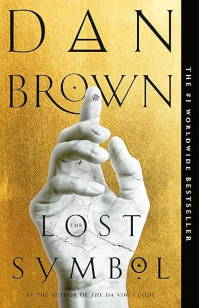
Dan Brown's The Lost Symbol continues the adventures of Robert Langdon, Harvard Professor of Symbology, a genius with an eidetic memory whose peculiar ability to interpret symbols lands him in hot water more often than his job description would lead you to suspect. This time around Langdon is summoned to Washington, D.C., by an old friend, Peter Solomon, who asks him at the last minute to give a talk in the Capitol's Statuary Hall. Needless to say, the trip doesn't go as planned, and Langdon finds himself plunged into yet another crisis, this one brought on by a religious crazy with a thing for tattoos. Saving the world—or at least the United States—involves Langdon in a sort of treasure hunt that leads him to explore the Masonic underpinnings of the country and the Masonic imagery that decorates many of its monuments.
I've enjoyed Dan Brown's books in the past because they are—or have been—page-turners. The Da Vinci Code, for example, starts with an exciting scene, as a killer chases the curator of the Louvre through the museum. Strangely—unfortunately—The Lost Symbol is very slow to get going. The action doesn't begin in earnest until about a third of the way in. Instead, there's a lot of exposition—Langdon explaining the significance of this or that symbol. When things do finally get moving, the story moves quickly, though it's still periodically slowed by further explanatory passages. Similarly, the final ten percent or so of the book is extremely dull, the surviving characters blathering on about religion with the unwelcome fervor of evangelical door-knockers. This 50-odd pages of boring (mostly) dialogue is tacked on after the dramatic stuff is over, which is to say that it's close to completely unnecessary to the story. It's also hard to believe, after everything the characters have been through by this point, that they'd opt to tour some Washington landmarks and lecture one another about religion and science instead of going home to nap. This part really should have been cut.
A few other things bothered me about the book. In no particular order:
- Inoue Sato, Director of the CIA's Office of Security, does not come off as a credible character. I also found it impossible not to picture her as the diminutive, accented seamstress in The Incredibles.
- Particularly in the first third of the book, the prose is interrupted frequently by the characters' italicized thoughts. Used more sparingly, this would have been fine, but it's overdone, the most mundane of thoughts sometimes meriting this kind of attention:
"Langdon left his coffee half made and hurried toward his study to return the call.
"I hope he's okay."
- In addition to threatening the lives of Langdon's friends, the chaos planned by this book's bad guy also threatens national security, as we're frequently told. Hence the involvement of the CIA. But while the impending crisis might indeed have serious repercussions, it somehow fails to terrify. It's rather like threatening someone with a really bad splinter that will eventually become infected and might result in the loss of a limb. Worrisome, to be sure, but it doesn't get one's attention the way, say, the threat of a gouged-out eyeball would.
- For all his brilliance and his ability to make startling intellectual leaps, Langdon sometimes comes across as profoundly stubborn and rather slow. (I actually beat him in recognizing the meaning of one series of symbols near the book's end. This does not speak well for Robert.)
- It was inevitable that some drama or other would play out in the pitch dark of pod 5 of the Smithsonian Museum Support Center, where Katherine Solomon, Peter Solomon's sister, has her lab. I thus understand why things had to be left dark for dramatic reasons, but for the life of me I can't imagine otherwise why the woman never invested in a flashlight.
In short, a lot bothered me about the story, but the main problem is that it's a good hundred pages too long. Cut out the lectures so the book is action-packed right out of the gate and doesn't end with a whimper, and it would be a much better read, on a par with the author's earlier works.
Member discussion