Jed Rubenfeld, The Interpretation of Murder
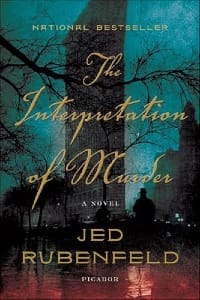
Jed Rubenfeld's smart thriller The Interpretation of Murder is inspired by a historical mystery. Sigmund Freud visited the United States only once, in August and September of 1909. He received an honorary doctorate at Clark University in Worcester, Massachusetts, where he also delivered a well-received series of lectures. It was an ostensibly successful visit, yet after returning to Europe Freud referred to Americans as "savages" and acted generally as if something terrible had happened on the trip. But what? Rubenfeld has written a fictional account of Freud's visit, taking the real-life riddle of Freud's animosity to the U.S. as his starting point.
Rubenfeld weaves two fictional mysteries around Freud's visit. The more engaging of the two concerns the torture and murder of a young woman found in a high-class hotel, a crime whose sadistic details are soon repeated in the bedroom of a second victim. Because of the sexual aspects of these crimes, Freud and his entourage become involved indirectly in their solution, but Freud's contribution to the story is minimal. Instead, Rubenfeld's protagonist is a wholly fictional character, Dr. Stratham Younger, an American psychoanalyst who takes on the role of amateur sleuth. Rubenfeld alternates in the telling between first-person accounts told from Younger's perspective and third-person narrative. The second, and secondary, mystery in Rubenfeld's book involves Freud more directly, as it concerns an attempt by mysterious parties to sabotage Freud's reception in the U.S. But in this story too, Freud himself takes a back seat. The Interpretation of Murder, that is, does not fall into the category of mysteries with crime-solving historical protagonists, such as Stephanie Barron's series of Jane Austen mysteries.
Rubenfeld's book is clearly well-researched. I was intrigued to learn that certain particulars involving one of the victims in the story come from Freud's case files. The story is also intricately plotted, and the solution of the mystery, when it finally comes, is both unexpected and complex—rather confusingly so, in fact. With one exception, Rubenfeld's characters are not emotionally compelling: Detective Jimmy Littlemore, the young policeman attempting to solve the crimes despite bureaucratic opposition, was the only truly sympathetic character. This isn't a book that will grab you by the throat, but one you'll come to appreciate instead intellectually. I might actually have preferred it if the secondary mystery, that surrounding Freud's reception in the U.S., were removed. The story would be tighter without it, and in fact, Rubenfeld's account of sadistic society murders could easily stand alone without the Freudian subplots. Freud himself is largely unnecessary to the story, though I realize that his appearance in the book may be its main selling point. As it stands, The Interpretation of Murder is not perfect, but it is a smart and engaging story, and worth the read.
Member discussion