Suzanne Collins, The Hunger Games
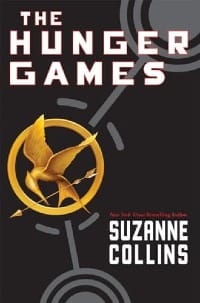
I kept hearing about The Hunger Games. On Twitter, in blog posts. People were referring to it with that "Oh my God you have to read this" language that gets one's attention. So I looked at the book's description on Amazon, and it didn't seem like my kind of thing: It's a futuristic YA novel set in a post-apocalyptic North America. The country of Panem has risen from the ashes of a continent devastated by (apparently) natural disasters. Panem is divided into twelve districts, each of which has its own specialty—agriculture or factory work or the production of luxury items. District twelve, in the Appalachian area, specializes in coal mining. It's among the poorest of the districts, if not the poorest, and its people struggle to keep themselves from starving. The book's protagonist, 16-year-old Katniss Everdeen, is from district 12. She's been feeding her family for years, since her father died in a mining accident, by poaching in the woods surrounding her community, an offense which could easily get her executed. But her time in the woods has also honed her survival skills, which will prove to be essential.
Panem is a Big Brother-ish society, the civil liberties of its citizens severely restricted. Among the demands made by the government is the annual participation by each district in The Hunger Games, a reality TV show to which each district must contribute two children as participants. They're selected in a lottery—the "reaping"—that isn't quite fair: the selection process favors the rich. The winners of the reaping are compelled to participate in the Games, a televised fight to the death in which there are no rules (though cannibalism is frowned on). The one participant who's left alive at the show's end is the winner and goes back to his or her district a fawned-over champion. If you're looking for antecedents, think The Truman Show mixed with Shirley Jackson's "The Lottery," 1984 and Survivor and the ancient Greek myth of the minotaur.
The bleak futuristic society aspect of the book was a turn-off for me. I decided I wouldn't be reading it.
Weeks passed, and again I started seeing references to The Hunger Games, comments prompted by excitement over the recent release of the second book in the series, Catching Fire. Again I went to Amazon. Again I thought I wouldn't like the book. But I downloaded a sample to my Kindle. That was about 24 hours ago.
It was immediately apparent from the sample that The Hunger Games was well written. By the end of the sample it was apparent that I would have to read the whole thing. I downloaded the book and devoured it, sometimes having to force myself to read more slowly because I was reading too fast, the literary equivalent of swallowing food unchewed. All of which is to say that the book is for some reason immensely readable. Katniss is a very compelling character: she's smart and motivated by sororal love; she's a survivor. But her character alone can't fully explain the book's appeal. The book never slows down. The evil government that imposes the Games on its citizens is easy to root against. The writing is flawless, at least as far as I could tell while gulping down the story. In particular, the author does an excellent job of describing the complicated details of the Games and the society of Panem so that they're easily digested and don't come across as instructional or out of place. It's a great, great read.
Member discussion