Simon Worrall, The Poet and the Murderer
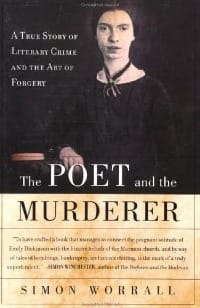
Simon Worrall's The Poet and the Murderer has probably made a lot of people angry. In it the author dwells on the shaky foundations of the Mormon Church, whose founder, Joseph Smith, is revealed as a sex-crazed charlatan. He also writes about the near criminal practices of auction houses, particularly Sotheby's, which seems to have deliberately ignored evidence that the "new" poem by Emily Dickinson it was auctioning was in fact a forgery. But the rest of us, who are neither Mormons nor Sotheby's employees, can only delight in Worrall's fascinating book.
The Poet and the Murderer tells the true-life story of Mark Hofmann, a disaffected Mormon with a genius for deception. Hofmann's forgeries—of Emily Dickinson, Abraham Lincoln, Mark Twain, Joseph Smith, Daniel Boone, and over a hundred other historical figures—were expertly produced, a feat that requires far more than the superficial replication of a subject's pen strokes. Hofmann used paper ripped from period books, manufactured his own ink, and wrote under self-hypnosis so that his forgeries would not be betrayed by evidence of hesitancy. Many of Hofmann's forgeries were intended to undermine the religion he had grown up to despise, the Church of Jesus Christ of Latter-Day Saints, by inserting into the historical record documents that were embarrassing to the Church. One could almost admire this man, who was so scrupulous in his work and so evidently intelligent—except that his crimes did not stop at forging.
Worrall also devotes much of his book to a discussion of Emily Dickinson, the "poet" of the title, as one of Hofmann's more daring forgeries was a poem that he composed and passed off as one of her lost works. Her reclusiveness, sexuality, handwriting, potential incontinence, and bizarre family life are all discussed, as is the sale of the Dickinson poem by Sotheby's years after Hofmann's imprisonment for murder. But while Dickinson shares equal billing with Mark Hofmann in the title of Worrall's book, The Poet and the Murderer has more to do with the Mormon Church than it does with Amherst's famous recluse. Not that there's anything wrong with that.
Nor is there very much wrong with this book. On a few occasions the author repeats himself. His narration in the Epilogue of a dream he'd had about Dickinson is perhaps a bit much. More importantly, when it comes, Hofmann's transformation from a brilliant and seemingly unassailable forger into a cash-strapped inventor of fraudulent investment schemes seems too abrupt. Why would Hofmann, who was otherwise so controlled, have adopted behavior almost certain to get him caught? Why, for example, did he accept nearly $200,000 as payment for documents he never intended to forge? Perhaps the answers to these questions were not forthcoming, and perhaps Hofmann's downfall was indeed thus abrupt.
One thing Worrall does particularly succeed at is transforming Hofmann in the reader's mind from a relatively harmless, almost admirable white-collar criminal into a reprehensible, sociopathic villain. Worrall's account of Hofmann's murders—to get creditors off his back he blew up two people with pipe bombs—and his description of the physical remains of Hofmann's two wholly innocent victims are chilling. And Worrall's book as a whole is gripping. Don't miss it.
Member discussion