Roderick MacLeish, The Man Who Wasn't There
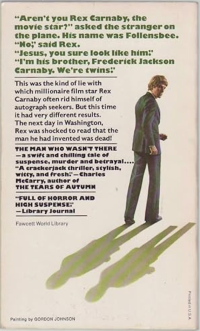
Rex Carnaby, the famous actor, gets on a plane and, as is his habit, adopts a fictional persona for his conversation with fellow passengers. This time he is Frederick Jackson Carnaby, the actor's twin brother, a wild animal dealer visiting Washington from Kenya. There's nothing unusual about Rex's flight or his performance as Frederick, but the next morning, Rex finds a picture of himself in the obituaries. The fictional Frederick Jackson Carnaby, it seems, has met his death en route from Washington to London.
The report of Frederick's death is the first in a series of events orchestrated by a certain "Follensbee"—we find out the mastermind's true identity only near the book's end—who is trying to drive Rex mad. In the weeks following the appearance of the obituary, Rex is haunted by voices in his house; by the creeping suspicion, cleverly planted by his tormentor, that he killed his own father as a child; and by the unwelcome attentions of a new member of his therapy group. Follensbee's reasons for persecuting Rex are not clear until his plot is finally revealed, but we do know that he intends for Rex, in his madness, to murder his own young son—the only full-blooded relative he has. As Rex's sanity unravels—rather too quickly—according to plan, it seems inevitable that he will act out the scenario Follensbee has conceived.
The plan of attack Follensbee has devised is indeed ingenious, though it depends on the assumption that a man driven to a state of "primal madness" must necessarily commit the primal crime, the murder of a family member. This assumption of the inevitability of Rex's murder once he is driven mad, however, is difficult to accept, and so one cannot be quite swept away by the book's plot. The Man who Wasn't There is nevertheless a decent, quick read that will keep you guessing, if not wide-eyed and glued to your seat.
Member discussion