Reading Herodotus
— Jeanette Thomas, Amazon.com
About the book
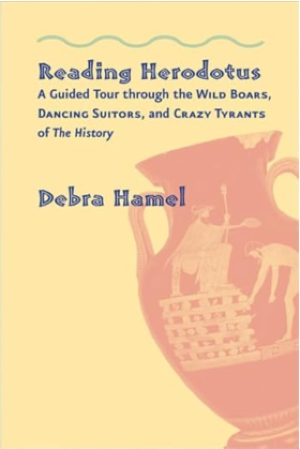
Debra Hamel’s book is a lively introduction to The History of the Persian Wars, Herodotus's account of Persia's expansion under four kings—Cyrus, Cambyses, Darius, and Xerxes—and its eventual collision with the city-states of Greece.
The History can be a long slog for modern readers, but it is full of salacious stories about sex, violent death, divine prophecies, and cannibals. Following the structure of the original work, Hamel leads the reader through a colorful tour of the central stories that comprise The History. She highlights the more interesting and important parts of the story while providing readers who are new to Herodotus with the background information necessary to appreciate the author’s wide-ranging subject matter. At once academic and a bit cheeky, the experience of this book is like reading Herodotus while simultaneously consulting a history of Greece and a scholarly commentary on the text.
Reviews
Ancient History: Resources for Teachers
"'All in all, Hamel has succeeded in writing an informative, engaging and entertaining introduction to Herodotus, the Greek world of his age and the Greco-Persian wars he narrates that surely will inspire many to engage with the author himself."
Classical World
"'But hold! I hear you cry. I had a cup of bull’s blood with my breakfast this morning and I’m just fine. And so you are. Because in fact bull’s blood isn’t poisonous....' So Hamel writes in just one of the witty passages in this loose retelling of Herodotus’ History. Her book, she promises, will contain only the 'juicy bits,' leaving the 'boring bits' safely out of sight on the cutting-room floor. Hamel delivers this and more: the 'guided tour' of her title is in fact undergirded by considerable scholarship—just enough to introduce readers to alternative accounts of important elements in Herodotus' work (the usurpation of Gyges, the death of Croesus) but not more than the general reader will be game for, and giving due consideration to occasions when Herodotus may have been misled by his sources. I learned from reading the book several things that I had not known—that a mule, for example, had in fact foaled in Colorado in the spring of 2007! (This was confirmed by DNA testing. So much for the impossibility of such a thing.) And speaking of animals, the discussion of woman-on-goat (or goat-on-woman) sex in Egyptian Mendes, also mentioned in Pindar fragment 201, gives rise not only to a discussion of Mendesian goats and Satanism but inspired Hamel to include (65) a remarkable 1854 drawing by Eliphas Lévi of the 'Baphomet of Mendes,' a memorable hybrid goat/human figure—with wings."
Choice Review
"Hamel...has excerpted 'juicy parts,' emphasizing anecdotage of eccentric 'barbarian' eating habits and medical remedies, tyrants misbehaving, and intermittent, acrobatic obscenities. Readers impatient with Saharan geography, catalogs of combatants, and Hellenic constitutional reform will savor these immoderate behaviors, e.g., in a chapter titled 'Horny Goats and Medicinal Urine.'"
The Classical Journal
"With glances out to fifth-century literary works (Bacchylides’ Ode on Croesus on the pyre, Aeschylus Persians) and forward to the Macedonian conquest of Persia and beyond, Hamel opens up a broad historical and cultural perspective. She includes much wondrous comparative material that the Father of History himself would doubtless have appreciated, for example on Vlad the Impaler (whose grim techniques are compared to Astyages’: 45), on the fascinating modern reception of Herodotus’ account of Amasis’ fart (76), and on other people reputed, like Pheretime, to have died by worms."
Bryn Mawr Classical Review
"A book like this should be useful not only for the general reader, but also for university students, especially in countries where no education in classical languages is regularly provided at the level of high school."
Ancient/Classical History at About.com
"As absorbing as a mystery story." Guide Rating 5 Stars
Danny Yee's Book Reviews
"Trying Neaira is written for the non-specialist—no knowledge at all of Greek history or literature is assumed—but endnotes provide references for the cognoscenti. It's a lot of fun to read, but Hamel's biggest service is in providing a radically different entry point to classical Athens, one that doesn't involve triremes or tragedies."
From the Back Cover
Timothy E. Duff, University of Reading
"Hamel presents Herodotus and his material in an original, illuminating, and entertaining way. By leading the reader through Herodotus’s text from beginning to end, the book provides an accessible introduction both to Herodotus and to an exciting period of Greek history, which culminates in the Persian Wars."