Ralph Leighton, Tuva or Bust! Richard Feynman's Last Journey
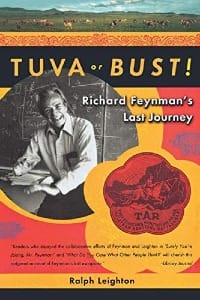
The obsession started with a simple question, posed after dinner in 1977, when the subject of conversation had turned to geography. Richard Feynman, the Nobel Prize-winning physicist who would later serve on the commission investigating the Challenger disaster (in 1986), asked his friend and drumming partner Ralph Leighton whether he knew what had become of Tannu Tuva. Leighton had never heard of the place and suspected he was being set up, but the Encyclopedia Britannica confirmed its existence. Tannu Tuva was once an independent country, but it became part of the Soviet Union in 1944. When Feynman and Leighton learned that the capital of Tuva was Kyzyl—a city without any proper vowels in its name—they knew they had to go there: "A place that's spelled K-Y-Z-Y-L has just got to be interesting!"
So began our heroes' eleven-year quest to reach Tuva, a more difficult project than you might imagine. Tuva, buried in the Asian heartland, was isolated, the Soviet Union was forbidding, and even basic information was hard to come by. (This quest, remember, was undertaken before the explosion of the internet. One catches oneself, when reading the book, thinking anachronistically about the task: why not just Google the place?) Eventually, of course, they learned an awful lot—about Tuvan throat-singing (my 1991 edition came with a 45!) and Kyzyl's main buildings, about Tuvan stone carvings and shamanism. And they communicated with Tuvans in Tuvan, using a Tuvan-Mongolian-Russian phrasebook that they turned into a Tuvan-Mongolian-Russian-English phrasebook.
Leighton's account of their various attempts to reach Tuva can be confusing—lots of names to remember of contacts who may or may not have wound up aiding in the effort. It all gets a bit muddied. And there is not as much of Feynman in the book as one would like. Tuva or Bust is primarily an account of Leighton's role in the quest, with Feynman making brief appearances now and then. Still, it is good to be in the physicist's company, however briefly, and it is good to be reminded, by this quixotic project of his, of Feynman's joy in experience.
Feynman fans, in short, will enjoy the book. Those who are not acquainted with him already, however, should become fans first by reading Surely You're Joking, Mr. Feynman! and What Do You Care What Other People Think? (Feynman was also the subject of James Gleick's Genius.) And then, when you're really hooked, get the CD of Feynman drumming and telling stories about his experiences as a safecracker.... (I am myself about to order another book about Feynman, No Ordinary Genius.)
Member discussion