Peter Carey, My Life as a Fake
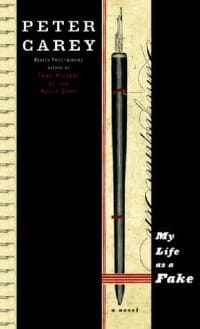
My Life as a Fake is, in the main, the story of unsuccessful poet Christopher Chubb, an Australian whose life is forever marred by a literary hoax he perpetrated in his youth. Chubb invented a deceased poet by the name of Bob McCorkle and passed off McCorkle's poetry—his own work, of course—on an unsuspecting editor whose ignorance Chubb wished to expose. (The story is based on a real-life literary hoax, the similar invention of a certain Ern Malley in the 1940s.) When Chubb first appears in the story, his stint as literary hoaxer is long behind him. He is filthy and destitute and quite possibly mad, employed as a bicycle mechanic on a cramped street in Kuala Lumpur. He is discovered there by Sarah Wode-Douglass, the editor of a London poetry magazine, to whom Chubb spins out the unlikely story of his post-hoax life. Wode-Douglass in turn relates Chubb's story to us:
The creature of Chubb's imagination, the fictional Bob McCorkle, was—or so Chubb was led to believe by the creature itself—given flesh by Chubb's pen. That is to say, someone who fit the description of Chubb's manufactured poet entered Chubb's life claiming to be the flesh-and-blood product of the hoaxer's fiction. Who or what this man is in fact is never fully explained. Whatever he is, the McCorkle creature endeavors, successfully, to destroy his alleged creator's life. The story of Chubb's ruin involves all manner of cruelties, but chief among them is McCorkle's kidnapping of Chubb's infant daughter, a crime which determines Chubb's unhappy future.
The better part of My Life as a Fake is narrated by Chubb to Sarah Wode-Douglass. Within Chubb's narrative, moreover, are remembered conversations, sometimes lengthy stories, which Chubb now recounts. But while much of the book might justly have been encased in quotation marks, there is not a single such punctuation mark to be found in the text. The result is not as confusing as one might expect, though direct and indirect discourse blend together into an inseparable mass of speech. Chubb's language, meanwhile, is often difficult to understand, an Australian English tinged with the expressions and verbal tics of his adopted country.
One reads the book increasingly curious to discover how Chubb came to be in his current situation, repairing bikes in Kuala Lumpur, but the read is not a wholly pleasant one. Chubb's convoluted story is interesting, but its narration leaves one with numerous questions, not the least of which involves the true nature and motivation of McCorkle. The story of Wode-Douglass, too, which frames Chubb's tale—her reasons for being in Kuala Lumpur, her interest in a collection of poetry by the monster McCorkle, her relationship with Englishman John Slater (her companion on the trip)—seems in the end to have been largely unnecessary. Too little, in particular, is made of the character of Slater, a likeable rogue who is put to little use in the story. Carey's novel is indeed bold and imaginative, but the truth in it is uncomfortably elusive.
Member discussion