Paul Murray, An Evening of Long Goodbyes
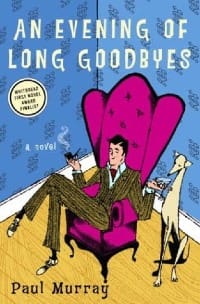
Twenty-four-year-old Charles Hythloday resides at Amaurot, his family's estate some ten miles outside of Dublin, with his sister Bel, an aspiring actress, and their Bosnian housekeeper, Mrs. P. Charles wiles away his days in apparent indolence and drunkenness, mourning a love affair gone sour, watching Gene Tierney movies into the night, overseeing the construction of a folly on the property. But to Charles's mind, his purpose in life is a serious one: he means to revive "the contemplative life of the country gentleman, in harmony with his status and history." For the first third of An Evening of Long Goodbyes, Charles is thus an amusing anachronism, a Wodehousian character thrust into a less polite modern world. This makes for some wickedly funny writing, both in dialogue and narrative. (Out to a seedy pub with Bel and her Golem of a boyfriend Frank, Charles looks around with some unease at his fellow drinkers. "Was I the only one in evening wear?") But one senses that Charles's retreat from society is motivated by an underlying sadness.
Unfortunately, Charles's idyllic lifestyle cannot last. Events conspire to push him out of Amaurot and into productive society, where he engages in activities—including paying work—that were previously unthinkable. Charles grows as a human being, developing empathy, for example, and he is eventually compelled to confront the imperfections of his childhood at Amaurot, which he had long glorified.
While Charles's development is interesting to watch, he becomes a less interesting character as he changes from a wry commentator on a society that is alien to him to a productive participant in that society. The book, too, loses charm as it moves from the farce of its early pages to the melodrama of Charles's post-Amaurot life. The book is still worth reading, a lighter version that kept Charles in tails and gimlets would surely have garnered five stars.
Member discussion