Muriel Spark, The Finishing School
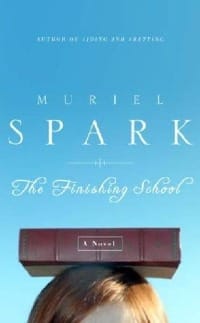
Rowland and Nina Mahler run an itinerant finishing school, College Sunrise, located for the time being in Lausanne, Switzerland. Rowland, an aspiring novelist, teaches the school's nine students creative writing, while Nina—whose fondest desire, strangely enough, is to be married to a scholar—instructs them in etiquette. ("There's no need to jump to your feet if one of your friend's parents comes into the room, far less your own. It looks too well trained.") Problems develop during the year described in Muriel Sparks' The Finishing School when Rowland conceives a powerful jealousy of 17-year-old student Chris Wiley. Chris is at the school to work on his own book, a historical novel about the murder of Lord Darnley, husband of Mary Queen of Scots, that takes jealousy as its theme. Chris manages to interest publishers and film producers in his unfinished manuscript with unlikely and, for Rowland, maddening ease. With Rowland's marriage suffering as a result of his obsession with Chris and with Chris himself showing signs of instability, with several of the book's characters announcing that the situation is ripe for murder, the end of the school year holds the promise of high drama.
Not that high drama is in fact delivered. Nor will readers care very much how the year wraps up for the College Sunrise students and faculty, for we never come to know the characters of Sparks' short book. Most are one-dimensional creatures whose names one needn't bother remembering from one page to the next. The two characters whose emotions are explored in the book—Rowland and Chris—are only slightly more fleshed out. Throughout, Sparks keeps readers at an emotional distance, "telling" rather than "showing," the reverse of the old saw about writing: "Nina now perceived that Rowland's jealousy was an obsession." Sparks' prose, sometimes stilted, fails to charm.
"The Sunrise group comprised eight, the ninth, Princess Tilly, having a pain in her stomach and so forced to lie on a sofa for some hours, on this her bad day of the month."
When the end comes—an abrupt section in which the characters' fates are revealed à la the film Animal House—one feels that one has read the literary equivalent of empty calories.
Member discussion