Malcolm Gladwell, The Tipping Point
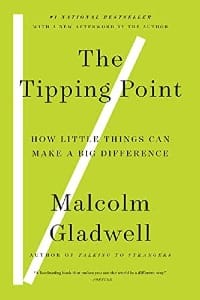
In his bestseller The Tipping Point, Malcolm Gladwell discusses the phenomenon named by his title, the point at which something—an idea, a virus, a fashion—becomes an epidemic, its growth accelerating exponentially. There are three characteristics of something that has "tipped": it is contagious; the change in its growth is dramatic rather than gradual; and the change is the result of small, ostensibly insignificant changes. But little changes, as Gladwell shows us, can have big effects.
In his first chapter, Gladwell lays out the three rules of epidemics, which he discusses at greater length in subsequent chapters. (1) Whether or not an idea tips depends in part on the messenger, if it's being spread by someone who is unusually connected (and can thus spread the idea among disparate groups) or unusually informed (and thus called upon as a source of information among his acquaintances), or else a very good salesman. (2) The successful spread of an idea depends in part as well on the message itself, whether it is "sticky." (3) Finally, its success depends on its context, the particular conditions—social or environmental, for example—in which it operates.
Gladwell considers numerous real-life examples while discussing the phenomenon of the tipping point—from Paul Revere's ride (a guy with connections and a sticky message!) to Bernie Goetz and the "Broken Window Theory" of policing to Sesame Street and Blues Clues and the Divine Secrets of the Ya-Ya Sisterhood. It's a fascinating read, one that will likely leave readers analyzing their own situations in light of Gladwell's comments. But what I most like about Gladwell's book is not so much what he says—though that's extremely interesting—but the way he says it. The Tipping Point is an object lesson in how to write nonfiction for a general audience. Gladwell manages to communicate complex ideas in remarkably clear prose, which is made further accessible by his repeated, timely restatements of his arguments to that point. All writers of nonfiction should aspire to communicate so clearly.
Member discussion