M.J. Rose, The Halo Effect (+ Author Interview)
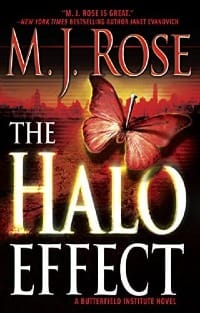
Dr. Morgan Snow, the protagonist of this first installment in M.J. Rose's new series of Butterfield Institute novels, is a perceptive therapist and a newly divorced mother, an expert in sexuality with, at least in recent years, more theoretical knowledge of the subject than hands-on experience. She is troubled still by an unusually sad childhood—details of which drip into the narrative of The Halo Effect—from which she emerged scarred with abandonment issues. Morgan is a fully realized, multi-dimensional, wholly likable character. And she is an unlikely amateur sleuth, which is part of the charm of Rose's new series: criminal suspense has not found a home before in the halls of a sex therapy clinic.
Morgan, who has worked with the police in past cases, becomes involved again when a serial killer begins murdering prostitutes and posing them, in death, in a series of religiously significant, grotesque tableaux. Dr. Snow numbers many prostitutes—both incarcerated and not—among her patients, so the crimes are of especial concern for her. But what is most alarming is the recent disappearance of one of her favorites: call girl Cleo Thane has enjoyed an almost Mayflower-Madamish level of success but may have put her career and person in jeopardy by writing a tell-nearly-all book about her high-powered clients.
The Halo Effect is not your usual suspense novel. Not only is the occupation of its principal sleuth unconventional, but Rose's writing is somehow similarly unexpected. She eschews hackneyed expression while bathing her subjects in rich description. See, for example, her oblique description of the (sub-)eponymous Butterfield Institute:
"There is a small brass plaque on the outside of the building, identifying it but giving little else away: The Butterfield Institute. The black cursive letters are etched deeply into the metal plate. Run your fingers over them and you feel the edges pushing into your flesh. Could you cut your skin on those edges and draw blood? Probably not, but even if you did, none of us inside could offer more than a Band-Aid."
As must be obvious by now, I liked Rose's book very much. And I am eager to read the second installment in the series, which will reportedly be released in April of 2005—farther off than I should like.
Author Interview
Originally posted July 25, 2004. I was sad to learn when preparing this for reposting that MJ Rose passed away in December 2024.
M.J. Rose is the author of five novels: Lip Service, In Fidelity, Flesh Tones, Sheet Music and The Halo Effect. She also is a contributor to Writer's Digest, Poets & Writers, Oprah Magazine, The Readerville Journal, and Pages. Rose is also the co-author with Angela Adair Hoy of How to Publish and Promote Online and with Doug Clegg of Buzz Your Book.
Getting published has been an adventure for Rose, who self-published Lip Service late in 1998 after several traditional publishers turned it down. Editors had loved it but didn't know how to position or market it since it didn't fit into any one genre. Frustrated, but curious and convinced that there was a readership for her work, she set up a website where readers could download her book for $9.95 and began to seriously market the novel on the internet.
After selling over 2500 copies (in both electronic and trade paper format), Lip Service became the first e-book and the first self-published novel chosen by the LiteraryGuild/Doubleday Book Club as well as being the first e-book to go on to be published by a mainstream New York publishing house.
Rose has since been called the "poster girl" of e-publishing by Time magazine, and she has been profiled in Forbes, The New York Times, Business 2.0, Working Woman, Newsweek, Poets & Writers and other publications, both in the U.S. and abroad. She has appeared on The Today Show, Fox News, and The Jim Lehrer NewsHour.
Rose graduated from Syracuse University and spent the '80s in advertising. She was the creative director of Rosenfeld Sirowitz and Lawson, and she has a commercial in the Museum of Modern Art in NYC.
She lives in Connecticut with Doug Scofield, a composer, and their very spoiled dog, Winka.
Visit the author's web site at http://www.mjrose.com.
1. Tell us a little about your most recent book, the erotic thriller The Halo Effect.
This is the first book in my new series featuring the sex therapy clinic The Butterfield Institute and psychiatrist Dr. Morgan Snow. The novel, with a mix of psychological suspense, intrigue and adventure, takes what I hope is a provocative look at sexual crime through the eyes of a woman who has devoted her career to studying and talking about them. Morgan is probably my favorite of all my characters—she's so real to me and her issues seem so heartbreaking and admirable at the same time. I've also been told that the book is impossible to put down and that I'm keeping people up all night. And honestly, I could not be more thrilled. There is no comment an author likes to hear more.
2. Are you working on a new book?
Yes, I recently finished the second book in the series and am going to be starting on the third as soon as I stop procrastinating. (Which I am doing by reading: John Searles's Strange But True, Caroline Leavitt's Girls in Trouble, Doug Clegg's The Hour Before Dark and my old favorite, Rebecca by Daphne duMaurier.)
3. Do you adhere to a schedule when you write? For example, do you write a certain number of pages a day, or write for a set number of hours?
Yes. When I'm working on a novel I write about four to five hours a day. In two to three hour spurts. I start at one in the afternoon.
I work from a very very short chapter outline and I race through the first draft and don't reread a word until I reach the end.
The second draft (my favorite) is a leisurely line by line edit where I question every word. I love nodding and rewriting. I once spent a week on a paragraph and was in heaven.
I've learned more about being a writer from John Gardner's book, The Art of Fiction, than from any other person or source and I highly recommend it.
4. In John Darnton's collection of essays Writers on Writing, author Kent Haruf reports that he writes his first draft with a stocking cap pulled down over his eyes. Have you anything similarly bizarre to report about your own writing habits? Or, more mundanely, how do you go about writing? Do you use a computer? Typewriter? Legal pads?
The strangest thing about my writing is the time I spend not writing. Two to three months before I start on the outline of a book, I make a very detailed scrapbook full of "stuff" from my character's life. I also have to have a talisman for him or her - some object that actually belongs to him or her. I wrote an article about this and you can read it here.
And that has lead to me teaching an online class on my process—details [here]—and I teach an online marketing class for authors too—click [here].
5. When did you know you wanted to be a writer?
First I fell in love with reading. Then I thought I wanted to be a writer. That was about 6 years old. But then I fell in love with wanting to be an artist and even went to art school and got my BFA. Then I went into advertising. At another point I wanted to be a sex therapist. But no matter whatever else I did or tried to do—I always wrote—even if I didn't think I wanted to be a "writer." So the real answer is that I was a writer before I even knew I wanted to devote my life to being one.
6. How many books do you read a year?
I read about one book a week, but at the same time I listen to one book a week on audio. So total is 100 books a year. I think the most important thing anyone who wants to be a writer or who is a writer can do is buy books and read. Not just to educate yourself with other writers' work so you keep learning, but to help contribute to the industry that you are in or want to be in. Writers who read the most get published. Really. The more supportive you are of other writers, the more books you buy and read, the more likely it is you will get published.
7. How do you decide which books to add to your books-to-be-read shelf or its equivalent? Do you rely on book reviews? Amazon customer reviews? Friends' recommendations? Random bookstore browsing?
Word of mouth is probably number one. I get that from [Readerville.com]—which is a site and a forum I am addicted to. Plus I read www.bookreporter.com and blogs like [http://www.sarahweinman.com/confessions/] and [http://marksarvas.blogs.com/elegvar/] religiously.
I also browse a lot and pick up books for their covers—then read the flap copy, then glance at blurbs or reviews—but it's really the subject matter that convinces me.
I also try to read the books of every writer who I meet and like.
8. Having stocked your to-be-read shelf, how do you select the book you'll read next?
That's a tough one. It's random. There are some books that stay on that pile for years. I keep thinking I'll get to it but I just don't. The only things that move up to the top of the pile are friends' books or a total favorite author's new book: Greg Iles, Daniel Silva, Katherine Neville, Robert Goddard, Alice Hoffman, Mark Salzman, Laurie R. King's Kate Martinelli Series, Carol O'Connell—and there are more I can't think of—any of those will get automatically put on top.
9. Have you had any interesting experiences arising from people recognizing you in the street? Have policemen declined to ticket a famous novelist, for example?
A teenager heard who I was and starting screaming. It turned out she and every girl in her eighth-grade class had passed along my novel Lip Service to each other and had even made up a lunchroom game based on the book: the girls who came up with the dirtiest pun—like the title—won and everyone would chip in and buy her lunch the next day.
I didn't know if I should be flattered or worried.
10. Finally, the desert island scenario. You wash up on an island that has, remarkably, an exceedingly well-stocked library, but which also has a schoolmarmish librarian who will only let you take out a total of five books the whole time you're there. You'll be stuck on the island indefinitely. What five books do you select?
Yikes. Five books is not five volumes. So. I'd take Marcel Proust's Remembrance of Things Past, which I have never read—but is long. And I'd take Ayn Rand's Atlas Shrugged. I like The Fountainhead better but Atlas is twice as long. Then I'd take Rebecca by DuMaurier because it is one of my top five favorite novels and I reread it every few years anyway and never get tired of it. Next I'd take Crime and Punishment and Les Miserables. Two classics I read in high school but am sure I completely missed.
The problem would never be not having the right books on the island—it would be being able to write on the island. Because for me writing is as good as reading. I just hope my books are as entertaining for the readers to read as they are for me to write.
Member discussion