Lemony Snicket, The End
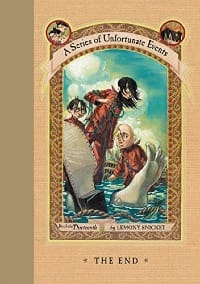
Lemony Snicket is back with the 13th and final installment (released, naturally, on Friday the 13th) of his A Series of Unfortunate Events, simply entitled The End. When the book begins, the orphans who are Snicket's unfortunate protagonists—Violet, Klaus, and Sunny Baudelaire—are adrift in a small boat with their nemesis, the unibrowed Count Olaf, who's been trying to get his hands on the Baudelaire fortune since the series began. Since he and the orphans are in the same boat, Olaf is certain the money is as good as his, and he imagines what he will do with it in a passage that demonstrates his wickedness and egocentrism as well as his creator's authorial playfulness:
"'I think the first thing I'll buy for myself is a shiny new car!' Count Olaf said. 'Something with a powerful engine, so I can drive faster than the legal limit, and an extra-thick bumper, so I can ram into people without getting all scratched up! I'll name the car Count Olaf, after myself, and whenever people hear the squeal of brakes, they'll say, "Here comes Count Olaf!" Orphans, head for the nearest luxury car dealership!'"
Olaf and the orphans finally come to land on a coastal shelf and soon meet the nearby islanders, castaways themselves, mostly, who have come to embrace the simple lifestyle urged upon them by the island's enigmatic facilitator, a certain Ishmael ("Call me Ish"). Everything washes up on the shores of this island eventually—documents and kitchen whisks and batteries, people and serpents who've been lost at sea—so it is not surprising that the Baudelaires are reunited there with a couple of old friends. They are also able to find amidst the island's collected detritus some information pertinent to their own history.
Considering the book apart from its role as the final installment in the series, The End is as good as many and better than some of Snicket's earlier books—better, certainly, than the tiresome, repetitious Penultimate Peril. Snicket continues to amuse with his verbal play:
"As I'm sure you know, there are many words in our mysterious and confusing language that can mean two completely different things. The word 'bear,' for instance, can refer to a rather husky mammal found in the woods, as in the sentence, 'The bear moved quietly toward the camp counselor, who was too busy putting on lipstick to notice,' but it can also refer to how much someone can handle, as in the sentence 'The loss of my camp counselor is more than I can bear.'"
And, delightfully, Snicket allows Olaf to become a more nuanced character. It is interesting, too, to see the pattern of the Baudelaires' lives altered: for once they encounter adults who are not taken in by one of Olaf's disguises. Intriguing questions are raised in the book—about Olaf's role in their lives, about Lemony Snicket's relationship with Beatrice, about Mr. Poe. One reads on, eager for answers.
The End being the end, however, one must consider how well the book functions as a conclusion. And here, alas, readers are apt to be very disappointed indeed. Granted, Snicket repeatedly makes the point in the book that all stories are interconnected and that no story ever really begins or ends: its threads reach infinitely into the past as well as the future. That is true in life, but we do expect authors to impose a neater structure on their stories. Fiction isn't real life, after all; it's life polished into something finite and graspable, with, usually, the boring parts removed. Snicket has, unfortunately, failed to answer a great many questions in his final book, and has at the same time raised several more. What, for example, became of the elusive sugar bowl that motivated so much action earlier in the series, and why was it important? What was the giant question mark that appeared so menacingly on the radar screen of the Queequeg back in book eleven? What familial relationship is implied by the fact that, as we are told, Violet was going to be called Lemony if she were a boy? It may be that some of the answers to these and other questions can be found in The Beatrice Letters, which was released a month before The End and which I have not read. But even if so, readers shouldn't have to look outside of the series itself to find simple resolution.
Mr. Snicket, I fear, has failed us. The End is another clever book from his drawing board, to be sure, but it is not enough for us to be told twelve books into the series that the author doesn't have all the answers.
Member discussion