J.K. Rowling, Harry Potter and the Half-Blood Prince
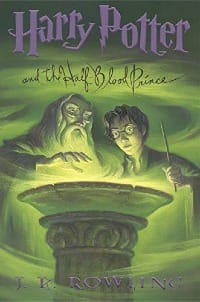
It's Harry Potter's penultimate year at Hogwarts, and things in the wizarding world—and the world of Muggles, for that matter—are not looking good. Voldemort is back and the Death Eaters, the dark wizard's evil minions, have begun claiming victims. Meanwhile, in the relatively safe haven that is Hogwarts School of Witchcraft and Wizardry, a new Defense Against the Dark Arts teacher has been installed, the sixth DADA instructor in as many years. And Hogwarts's newest faculty member, a certain Horace Slughorn, seeks to gather Harry—"The Chosen One," as the Daily Prophet is now calling him—into his flock of favorites. Harry, however, is spending his time instead in the company of Hogwarts's headmaster: he and Dumbledore clamber about in other people's memories throughout much of the book—a trick achieved with the use of Dumbledore's handy Pensieve. Ron and Hermione, not privy to these adventures, pass their time instead simmering at a slightly higher temperature than usual. The book simmers as well, building slowly, almost quietly, as Rowling plays with readers, making us wonder repeatedly whether we know for certain where her characters' allegiances lie. We find out for certain—or so we must think, anyway—in the dramatic events that unfold toward the book's end, when the identity of the Half-Blood Prince of the book's title is revealed and Rowling's latest read becomes—fans will not be surprised—nearly unputdownable.
One can criticize J.K. Rowling's sixth book on a few counts. The author does not throw out very many life preservers to those of us who have not recently read or reread the earlier books in the series, frequently alluding to characters and events from previous installments without reminding us of their significance, which can be confusing. The identity of the Half-Blood Prince, too, once revealed, is not as important as readers are led to expect. And the final chapter of the book, while some of its material is necessary to complete the story, is overlong and makes for an unfortunately dull conclusion. But these are relatively small complaints. After many thousands of pages, Rowling's prose continues very much the same—a kind of straightforward, unaffected writing that gets the story across without slowing things down, a style that has proved unusually accessible to a vast readership. In the six volumes of her oeuvre, Rowling has carefully and vividly brought to life a complex, fully realized world, plucked from her imagination, one that will stand on its own and continue to engage the imagination of audiences long after Rowling herself is able to oversee it (much like the universe of Gene Roddenberry's Star Trek in this respect). Her creation of this alternate world, so real to her readers, is, I believe, a remarkable achievement.
Member discussion