Steven D. Levitt and Stephen J. Dubner, Freakonomics
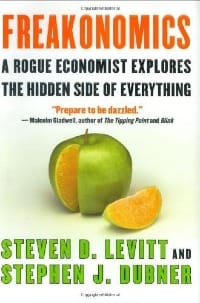
I'm late to the party reading Freakonomics, Steven D. Levitt and Stephen J. Dubner's bestselling exploration of, well, a whole bunch of stuff. The book is based largely on research previously published by Levitt, an economics professor at the University of Chicago. And it is rendered into clear, accessible prose by Dubner, who writes also for the New York Times and The New Yorker. Levitt applies the tools of economics—the means by which economists sift and assess scads of data—to a variety of unlikely, non-economic subjects. The subjects addressed in Freakonomics include, for example, the factors that led to a dramatic decrease in crime in the U.S. beginning in the early 1990s, whether sumo wrestling is corrupt, and how Superman was instrumental in diminishing the power of the Ku Klux Klan in the mid-20th century. Many of Levitt's conclusions are counterintuitive, which is what makes the book fun reading.
Throughout, the authors stress five fundamental ideas, outlined in their introduction:
- Incentives are the cornerstone of modern life.
- The conventional wisdom is often wrong.
- Dramatic effects often have distant, even subtle, causes.
- "Experts"—from criminologists to real estate agents—use their informational advantage to serve their own agenda.
- Knowing what to measure and how to measure it makes a complicated world much less so.
This pretty much sums up what the authors have to say in general. What remains is simply how these ideas are manifested in the particular cases considered in the book.
As the authors themselves admit, Freakonomics is unlikely to change your life, though it may leave readers more apt, at least temporarily, to question their assumptions. That may be reason enough to give the book a look, especially as it's so easily digested.
Member discussion