David Lindley, Degrees Kelvin
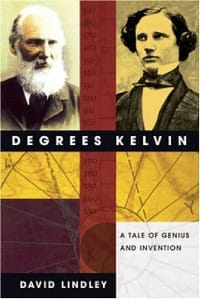
British physicist Sir William Thomson, better known to history as Lord Kelvin, was among the most brilliant scientists of the 19th century. Already a published author upon his arrival at Cambridge as an undergraduate (in 1841), Thomson went on to a distinguished career during which he made advances in the studies of electricity and magnetism, heat, and light, as well as establishing the existence of an absolute zero—the work with which he is probably most readily identified. But Thomson was, above all else, a practical thinker who most enjoyed applying scientific principles to the solution of real-life problems. Thus, while involved in the various attempts that were made to lay the first transatlantic telegraph cable, Thomson invented the mirror galvanometer, a more sensitive instrument for receiving electronic pulses than had previously been available. Likewise, Thomson's interest in sailing led to his invention of sounding machines for aid in navigation and the design of a more reliable naval compass.
Lindley's account of Thomson's life and career alternates in the telling between discussions of science and of personality. The former will be appreciated by readers with some scientific background, but Lindley does not dumb down his technical discussions sufficiently for the aid of the general reader. Far more accessible is Lindley's discussion of Kelvin's life outside of the laboratory, as for example his account of the subtle battle between the young William and his somewhat domineering father James—over the former's expenses, attentiveness to school work, social contacts, moral probity, exercise, conduct of professional relationships, and so on. James Thomson was involved in the particulars of William's life and early career to a degree that must have been maddening to the young man. (Much of their struggle revolved around a position that opened at Glasgow University, where James Thomson was a professor of mathematics. James wanted desperately for his son to work at the University. William got the position, at the age of 22, and stayed there for more than fifty years.) There are, too, rewarding accounts of the various luminaries with whom Thomson came into contact, such as the autodidact Michael Faraday (whose accomplishments and personality have clearly impressed the author).
Lindley frames his biography with a discussion of the unfortunate fact that he became in his later life something of a dinosaur, clinging stubbornly to antiquated ideas—such as an upper age for the earth of a mere 100 million years—while science advanced around him. Celebrated in his life, Kelvin has suffered a posthumous diminution of reputation. Such is the "tragedy" of Lindley's subtitle ("A Tale of Genius, Invention, and Tragedy"), but it is overstated. Kelvin's life was filled with frenetic, joyous work on projects that fascinated him, and he was appreciated during his lifetime for his contributions. If in some areas Kelvin's conclusions were wrongheaded, he was yet responsible for substantial scientific advances. He seems to have been a wholly fascinating figure, and Lindley does a service in making his story available to readers.
Member discussion