John Shors, Beneath a Marble Sky (+ Author Interview)
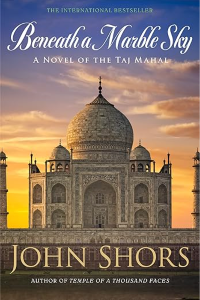
When his beloved wife Mumtaz Mahal died during childbirth in 1630, Shah Jahan, the emperor of Hindustan, ordered that a magnificent mausoleum be erected for her. Tens of thousands of laborers and craftsmen worked under the eye of the project's master architect, Ustad Isa, for more than a decade. And when the mausoleum's last gleaming white marble slab was fitted into place the world had one of its most treasured monuments, the Taj Mahal.
In his marvelous debut novel Beneath a Marble Sky, author John Shors has taken what is known of the historical circumstances of the mausoleum's construction and created from that bare-bones account a rich, gripping narrative. The story is told by Princess Jahanara, the wily daughter of Shah Jahan and Mumtaz Mahal. At the book's outset she is an old woman, telling her granddaughters the story of her life for the first time: Hindustan is then too dangerous a place for relatives of the reigning emperor, and the girls had been too young previously to be entrusted even with the knowledge that they were of royal blood. The story Jahanara tells is a grand one. Beginning with her childhood among the chattering women of the royal harem, she tells of her mother's strength and intellect and of her parents' devotion to one another, and she introduces readers to her many siblings, in particular two of her brothers, the bookish Dara—the presumptive heir to the throne—and Aurangzeb, whose cruel streak in boyhood would mature into a lust for power and violence that would ultimately threaten not only his family but the empire itself. In the course of her narrative Jahanara tells two love stories—her own and that of her parents—but much of her story is bleak: there is her loveless marriage to the abusive Khondamir, her mother's death, her brother Aurangzeb's instigation of a civil war, her separation from her daughter. She is sustained throughout by her father, her lover, and by two very solid friendships.
Most books, however engaging they may be in the reading, ultimately aren't memorable. Over time their plots and characters slip away, and one is left not with a true memory of the book but, at best, with a general sense of one's reaction to it—that it was thrilling or slow, well-written or clumsy, that one would want to read more by the same author or not. But because Beneath a Marble Sky is not only engaging and beautifully written but also tied intimately to a cultural monument, I think that it will live in its readers' imaginations far longer than most books, its story called to mind whenever one encounters references to or pictures of the Taj Mahal. Shors does a service in breathing life into the mausoleum and the historical figures and circumstances that created it. And he's done it beautifully.
My one suggestion for improvement is that the author add a historical note to subsequent editions of the book, detailing for readers what is known about the characters whose lives he has depicted.
Author Interview
Originally posted May 25, 2006.
Today I'm interviewing John Shors, who is the author of Beneath a Marble Sky, a novel about the circumstances of the Taj Mahal's creation. As you can see from my review, I thought quite highly of it. The book was originally published in 2004, but it's coming out in paperback, well, right about...now, and with a beautiful cover.
1. Can you tell us a little about Beneath a Marble Sky?
Beneath a Marble Sky is a work of historical fiction and is based on the remarkable story behind the creation of the Taj Mahal. My novel chronicles both the rise of the Taj Mahal and the civil war that consumed Hindustan (India) immediately after the mausoleum's creation. My heroine, Jahanara, was involved in both the building of the Taj Mahal and the following war, and my story centers on the trials and triumphs of her life. Though Beneath a Marble Sky is a love story at its core, my book also contains a great deal of intrigue and action.
2. So, why the Taj Mahal? Was there a specific aha! moment when the idea for writing a novel about the mausoleum came to you?
I've been lucky enough to spend a great deal of time in Asia and have been powerfully influenced by its history, as well as the sights, sounds, smells, and customs found today in that part of the world. For a decade I've wanted to write a novel set somewhere in Asia but waited to find the right story—or rather to have the right story find me.
In 1999, my wife and I were traveling in India and of course made it a point to visit the Taj Mahal. We arrived at the mausoleum as soon as it opened to the public and were the first people there that day. Walking within its chambers, hearing our voices echo in the same manner as voices did hundreds of years ago, and touching its sculpted walls was an overwhelming experience. Seeing the wonder of the Taj Mahal, and understanding that a man built it for his wife—a woman he cherished above all else in life—was uniquely inspiring. Indian poets have been writing about this love story for centuries. And yet, not many people in the West know the tale. I realized that I had to tell it. Quite honestly, I was amazed and delighted to discover upon my return to America that no one in the West had ever fictionalized the story.
3. What is your writing schedule like?
I typically try to write about four hours a day. I give myself defined goals, and I don't quit until I reach those goals. During a first draft, a goal might be to write eight pages a day until the book is complete. Farther down the road, when I'm editing, for instance, my goal might be to edit 30 pages a day. I don't allow myself to leave my computer until I've met whatever goal I made for myself.
I'll be honest—most of the time writing is without question extremely hard work. Having said that, moments of clarity exist that are profoundly enjoyable. For me, during such moments, characters seem to speak of their own accord, and scenes unfold as if I've already lived them. When I am in such a groove, I type as fast as I can, not caring if words are spelled properly or if everything makes perfect sense. As I type, the outside world simply disappears. I don't think about what might be happening over the weekend or bills that need to be paid or house projects with my name on them. I'm simply consumed with writing as much as possible during this rare moment of clarity. What's best about these moments is that as I write I experience a remarkable sense of contentedness—likely because I know that I am creating something that most people will find enjoyable. When reality inevitably chases me away from the computer, I always depart with great regret.
4. Can you describe how you go about the process of writing—that is, with or without outline and exhaustive character sketches, on computer or only on legal pads while lounging in bed, that kind of thing?
I'm not a very organized person, and hence I'm not an author who creates massively complex outlines and then follows them to perfection. Of course, I thought Beneath a Marble Sky through before I started writing. But I did so in broad brush strokes, and then I filled in the details as I wrote. I edited my novel 56 times, so I was constantly adding material, further refining the prose, etc. Over the five years that I spent working on this novel, I was almost constantly thinking about it, wondering how I could improve it. Thankfully, I finally reached a point where I didn't think I could make it any better.
5. Beneath a Marble Sky is your first book—or at least your first published book. Do you have other manuscripts hidden in your closet?
Well, I've written a few drafts of other novels over the years. I grew up reading three or four books a week, and I've always been working on one story or another. When I was a teenager I wrote a fantasy novel that will never see the light of day (fortunately for me). When I was in college I wrote several novels that allowed me to experiment with the written word. Beneath a Marble Sky was the first book I was really confident about in terms of selling it to a publisher.
6. What are you working on now? Beneath a Marble Sky is historical fiction, of course. Do you see yourself staying with historical topics in future books? If so, would you stick to the same time period, or are you interested in writing about other historical eras and places?
Right now I am focused on promoting Beneath a Marble Sky. Penguin Books is releasing a beautiful trade paperback of Beneath a Marble Sky on June 6th, and I am trying to publicize this as much as possible. I'm excited about the trade paperback as it has a wonderful new cover, a reader's guide, an author Q &A, information on how to contact me, and some other new things—things not included in most books. Many people are excited about Penguin's version (including the group in Hollywood that bought the film rights to my novel) as Penguin is putting some muscle behind my book.
7. Is there anything you'd like to tell readers that I haven't asked you about?
I'd just like to thank everyone for their support. It's truly an honor to have people reading and enjoying my novel, and I'm grateful for everyone's support. Also, if people want me to call into their book club (via speakerphone) I'm happy to do that. Simply email me your request at [old email]. I wish everyone the best.
Member discussion