Barry Unsworth, The Songs of the Kings
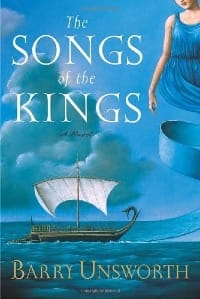
Barry Unsworth shines light on an early event from the annals of the Trojan War—that dark period when the allied Greek fleet was massed at Aulis on the eastern coast of Greece, ready to set out across the Aegean to Troy, but was prevented from sailing by adverse winds. As Unsworth tells it, the assembled Greeks are growing increasingly contentious with the delay, and some remedy is required. The man with a plan, naturally enough, is wily Odysseus—star of Homer's Odyssey—here presented as a Machiavellian manipulator of words and men. Charmingly enough, he is wont to affect being lost for a word, and he compliments whoever supplies him with one with a very British sounding "Brilliant!"
Also on hand are those sons of Atreus, Agamemnon—the commander-in-chief of the operation, from whom a sacrifice is allegedly demanded by Zeus if the ships are ever to get underway—and Menelaus, wronged husband of Helen. You will remember that Helen was spirited away from her home by the Trojan prince Paris, the offense which was the direct cause of the Trojan War (her face launching a thousand ships and all that). Unsworth's Menelaus is a comical buffoon who can't wrap his mind around the possibility that Helen may have run off willingly:
"Must I remind you that my Helen is currently in a Trojan dungeon, being violated on an hourly basis? And I've told you before, she wasn't seduced, she was kidnapped."
The two Ajaxes are similarly comical, Ajax of Salamis a big dolt of a fellow who is trying to organize a series of games, and Ajax the Locrian a foul-mouthed, wiry guy who is equipped for some reason—unrealistically, I should think—with a more-or-less permanent erection.
As the story goes, Agamemnon sends for his daughter Iphigeneia to come to the fleet at Aulis—I shan't tell you why. Thus we have, in the second part of the book, a glimpse of the princess's life at Mycenae. There one evening she tells her slave Sisipyla the story of her family's proud history of incestuous cannibalism: how her great-grandfather Pelops was mashed into a tantalizing stew by his father Tantalus and served to the gods (he got better), and how her grandfather Atreus in turn butchered his brother's three sons and served them up to their father. Sisipyla, hearing the story and thinking to comfort Iphigeneia, who seems strangely affected by the telling of her family's exploits, says, "It's always the children who suffer, isn't it?" A great line.
Unsworth's prose, as you've probably already noticed, is less stilted than one often finds in historical novels, for which I applaud it, though it is admittedly an odd experience to hear his loin-girded characters speak of "collateral damage," or to hear Agamemnon's scribe say of the hero Palamades, "[H]is father was one of that band of heroes who sailed with Jason on the Argo in the quest for the Golden Fleece. That's the sort of thing that is bound to look impressive on a person's CV."
Readers who are already familiar with the story of Iphigeneia at Aulis will know more or less how Unsworth's story goes. Or will they? Because there is that alternate ending in which the goddess Artemis steps in and saves the day at the last moment....
Member discussion