Audrey Niffenegger, The Time Traveler's Wife
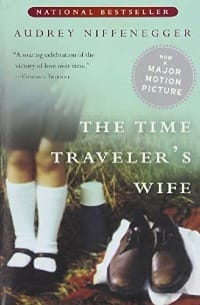
Librarian Henry DeTamble suffers from an unusual disorder that affects his body's genetic clock. The result is that he sometimes disappears from the present, leaving nothing but a pile of clothes behind him, and materializes stark naked in some other time and place. Without resources in his new time, Henry needs to survive by stealth and speed—stealing clothing and money, outrunning (or trying to outrun) the police, by whom he is frequently arrested.
"[T]here are several outstanding warrants for my arrest: breaking and entering, shoplifting, resisting arrest, breaking arrest, trespassing, indecent exposure, robbery, und so weiter. From this one might deduce that I am a very inept criminal, but really the main problem is that it's so hard to be inconspicuous when you're naked"
The adventures Henry has when chronologically displaced are alternately dangerous, or sorrowful, or life-changing. He sometimes visits himself in the past—and, similarly, is visited in the present by past and future selves. (His teenage selves engage in what must be a peculiarly effective form of auto-eroticism: Niffenegger has thought of everything.) He is made to repeatedly re-witness emotionally fraught incidents from his past. Principally, however, as its title suggests, The Time Traveler's Wife is the story of Henry's relationship with Clare, who so often finds herself waiting for her husband to return to her. This being a time travel book, Henry's relationship with Clare is not straightforward. They first meet when he is 36 and she is 6, and they meet again for the first time when Henry is 28 and Clare 20. The story of their life together is told from both of their points of view in brief, dated sections that chronicle Henry's jumps into and out of Clare's life.
Given her premise, Niffenegger might have concentrated on the gee-whizness of Henry's condition, telling us in greater detail about the cool stuff that happens to Henry when he time travels (bumping into his parents during his own infancy, for example). But the author's account is instead a serious consideration of the practical effects of Henry's condition on his life: his unexplained absences from work (and his naked reappearances in the library's stacks), the dangers inherent in his driving or flying, the possibility of materializing in some life-threatening circumstance, the disruption to his family life, and so on. I would myself have enjoyed reading a bit more of the gee-whiz stuff—and less about the protagonists' dreams. And I would have liked to read about some of the more dangerous episodes in Henry's time-traveling career, the fight-or-flight situations to which Niffenegger only alludes. But quibbles aside, The Time Traveler's Wife is a very cleverly conceived and well-written book. One hopes the author is already at work on a second novel.
Member discussion