Amir Aczel, The Riddle of the Compass
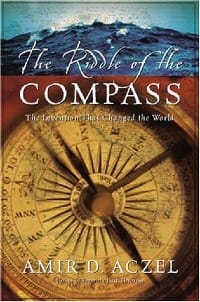
Amir Aczel spent his childhood on the Mediterranean Sea—literally—sailing around in and sometimes steering a passenger ship that was captained by his father. This romantic personal history makes Aczel particularly suited to tell the story of the compass, which so improved navigation in the late 13th century that it sparked a commercial revolution and made possible the Age of Exploration that was to follow.
In his highly readable narrative, Aczel provides a brief history of navigation centered on the compass—from navigation by stars and sounding lines to the naval supremacy of the Venetians in the 14th and 15th centuries to the masterful sailing of the great explorers—da Gama, Magellan—who opened up the world in the 15th and 16th centuries. We learn, too, about the early invention of the compass in China, where it was evidently not used at sea, and of its perfection as a naval instrument in the Italian city of Amalfi.
The Riddle of the Compass is at its best when Aczel discusses the actual "riddle" to which the title of the book refers: the question of the historicity of a certain Flavio Gioia, whom the people of Amalfi credit with having invented the mariner's compass in 1302. Most interestingly, the question of this Gioia's existence involves the correct interpretation of a single Latin phrase, a reference to the invention of the compass in an early 16th century commentary on the poetry of Lucrezio Caro.
Readers of Dava Sobel's popular book Longitude, which tells the story of the invention of the naval chronometer, will enjoy Amir Aczel's equally readable history of the compass.
Member discussion