Rebecca East, A.D. 62: Pompeii
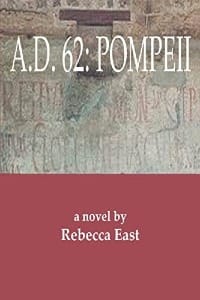
Miranda, the protagonist of Rebecca East's A.D. 62: Pompeii, is a graduate student studying classical archaeology at Harvard. It turns out that her knowledge of ancient cultures and her relatively small size make her the ideal candidate for a time travel experiment being conducted by unnamed researchers. The science behind the experiment and the particulars of its financing are never spelled out, but our heroine is due to earn a hefty sum as a guinea pig. The plan is for her to be sent back roughly 2,000 years to ancient Rome, though the scientists won't be able to pinpoint precisely either her location upon arrival or the exact date. She is to live among the natives for a few days, attracting as little attention as possible, and then return to the 21st century by activating the transmitter that's embedded in her upper arm.
Unfortunately, things don't go as neatly as planned. Miranda lands in the middle of the Mediterranean—fortunately near a fishing boat—in 61 A.D., during Nero's reign. Eventually, after a series of unpleasant experiences, she finds herself in Pompeii, working as a slave in a wealthy household in the shadow of Vesuvius—18 years before the mountain is due to bury the city in ash. And the transmitter in her arm proves to be a less-than-reliable escape route.
I have two quibbles with East's novel. The first is minor, and is addressed by the author to an extent when she introduces Miranda as a "walking encyclopedia": I find it hard to believe that a graduate student, however many years of Latin under her belt, or indeed any modern Latinist would be able to communicate as effectively as Miranda does upon first arriving among real-life Romans. My second complaint, more substantial but easily fixed, is that the author very often repeats information in the book that we've already heard. But a good editor would, I think, make quick work of excising the redundant passages.
Apart from these quibbles, this was a thoroughly enjoyable read. The world into which Miranda is thrust is well imagined. Background information about the ancient world is woven deftly into the story, so that the book never (or perhaps only once) reads like it's trying to teach us something. The plot, too, is very believable (once you accept the notion of time travel, of course): send a 21st-century woman back to Nero's Rome and it's plausible that she would have this kind of experience, that she would encounter just such problems while trying to assimilate. I was pleased, too, that the book does not suffer from the stilted language that is so common with historical fiction.
In short, I really enjoyed this novel, far more than I expected to. The book is self-published through iUniverse. Here's hoping that the author will find a wider readership for this story through a traditional publisher.
Member discussion